
Hantavirus: Another Pandemic Push

Hantavirus has ramped up in the news following a recent ocean expedition in the South Atlantic. As at 13 May 2026, the World Health Organization have reported eleven hantavirus cases and three associated deaths, in passengers aboard a Dutch cruise ship, MV Hondius. Below is a short summary of what is known about this virus and its connection to the burgeoning biosecurity health agenda.
What is Hantavirus?
South Korean virologist Ho Wang Lee is said to have discovered the virus in lung tissue of striped field mice in 1976. He named it Hantaan Virus, after a river on the South Korean peninsula, where these mice are predominantly found. It is said that this discovery explained an outbreak of haemorrhagic fever in over 3000 US and UN soldiers during the Korean War more than twenty years prior. A rodent-hantavirus ecosystem has since been postulated, claiming specific hantavirus strains associated with specific rodent species.
Transmission to humans is thought to occur through contact with the body fluids of contaminated rats: urine, saliva and faeces. The World Health Organization estimate between 10,000 and 100,000 hantavirus cases occur in humans each year in Asia, Europe and the Americas.
The virus is said to cause two separate severe clinical syndromes. Haemorrhagic Fever with Renal Syndrome (HFRS) begins with a range of influenza-like symptoms and progresses to acute kidney failure, with disease severity differing between the strains responsible. Hantavirus Pulmonary Syndrome begins with influenza-like symptoms and progresses to respiratory and cardiac symptoms.
The WHO Interim Guidance on laboratory testing of Andes Virus recommends laboratory testing of blood samples using PCR to detect genetic segments of the virus (and genome sequencing), and serological assay to detect anti-hantavirus antibodies which appear shortly after symptoms appear. Results must be interpreted alongside clinical presentation and epidemiological exposure.
Both tests come with the potential for false positive results. The WHO guidance admits that serology testing comes with a risk of false positive results due to cross-reactivity with other viruses and ‘interference material’ such as rheumatoid factors.
We first wrote about the misuse of PCR testing in July 2021, a few months after the January 2021 Corman-Drosten Review Report blew the lid on the corruption and scientific flaws involved with covid PCR tests. In a recent discussion on hantavirus, French neuroscientist Professor Martin Zizi, who has run a Belgian hantavirus research/sentinel laboratory, stated the following which highlights the flaws in using PCR as a diagnostic.
PCR is the perfect tool to generate whatever you want depending on how you calibrate it. Because PCR doesn’t equate to contagion. PCR doesn’t equate to disease. Especially in non-symptomatic patients. PCR is not a good fishing trip test because it’s pre-test predictive value is very very low. And the specialists know what I mean by the words.. Every doctor, every molecular, every clinical biologist, hear my words. The pre-test predictive value of any PCR testing is extremely low. That means that you cannot use it for first-time diagnostics.
The case fatality rate (calculated from diagnosed individuals) varies from <1% – 50%. The infection fatality rate is unknown, as this would require knowing how many undiagnosed infections (including asymptomatic and mild illnesses) occur. Professor Johan Giesecke explains this simply on page 7 of his 2017 publication Modern Infectious Disease Epidemiology. It is interesting to note that where hantavirus infection is endemic, up to 45% of the local population tests positive, suggesting that the infection fatality rate is likely very low.
A figure for case-fatality rate is largely dependent on how many of the milder cases escape diagnosis. The very high figures initially cited for the case-fatality rate in haemorrhagic fevers, such as Lassa fever, were probably largely explained by the fact that many of the more benign cases went undetected by the local health authorities.
The Journey of MV Hondius, April 2026
As reported by El Pais International, MV Hondius departed Ushuaia, the capital of Tierra del Fuego at the southern tip of mainland Argentina, on 20 March 2026, with 88 passengers and 59 crew members on board. The cruise began with a number of Antarctic excursions before returning to Ushuaia. On 1 April they departed north, towards their final intended destination, Cape Verde off the north-west African coast.
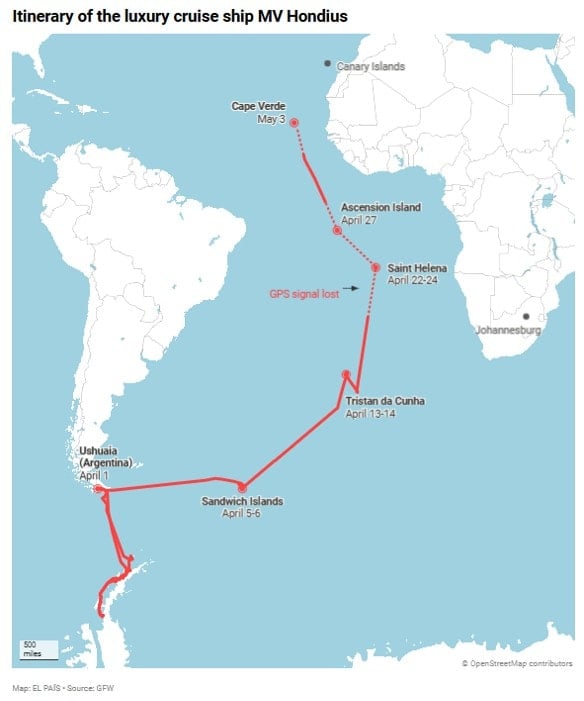
On 6 April, as the ship was sailing in the South Sandwich Islands, a 70 year old Dutch ornithologist traveling with his wife fell ill with fever, headache, abdominal pain, and diarrhea which progressed to acute respiratory distress. He died on 11 April and his body remained on board the traveling ship until 24 April when they docked at St Helena, off the Angola Coast.
During preparations for repatriation home with her husband’s body on 25 April, the 69 year old wife of Case One began experiencing gastrointestinal symptoms. She deteriorated en route to Johannesburg and died in hospital on 26 April. PCR testing detected hantavirus.
On 24 April a 69 year old male British passenger developed respiratory symptoms and was evacuated from Ascension Island on 27 April. He was admitted to an intensive care unit in a Johannesburg hospital, where PCR testing is said to have confirmed hantavirus on 2 May 2026.
On 28 April, as the ship sailed north of Ascension Island, an 80 year old female German passenger developed fever and malaise, progressing to pneumonia. She died on board the ship on 2 May. Post mortem samples sent to Europe sequenced the Andes strain of hantavirus, which is only found in South America and the only strain said to be associated with any (very rare) human-to-human transmission.
Since then, eight more cases have been detected using PCR testing. Most recently a Canadian with mild symptoms tested “presumptive positive” until confirmation can be made by a national microbiology laboratory.
On 11 May 2026 MV Hondius docked at the port of Granadilla on Tenerife in Spain’s Canary Islands. Asymptomatic passengers and crew, donning face masks and flimsy plastic coats and hats, disembarked amidst a confusing parade ranging from high profile suit-and-ties, to hazmat suits.
Hantavirus Public Health Response
WHO Director-General Tedros Ghebreyesus flew into Tenerife to oversee the military style disembarkation operation. He is seen in the above video standing near the open door of a bus carrying staff and passengers in varied personal protective regalia despite all testing negative. As we saw repeatedly through the covid era, there are two classes: those required to follow nonsensical rules and those who make the rules.
Interim Guidance from the WHO on Management of contacts of Andes virus (ANDV) cases from the MV Hondius cruise ship, suggests that many if not most passengers and crew members likely meet the criteria for “high risk contact”, who are recommended quarantine for 42 days after last known exposure.
At various media events including a press conference on 16 May 2026, Ghebreyesus has used the outbreak as an opportunity to repeatedly call for “solidarity”. This is a popular catchcry of the United Nations (for example here and here) as a solution to multiple global problems. Our prior articles relating to the International Health Regulations (for example here) show that what they really mean is “obedience”.
World Health Organization have concluded with weak evidence that the first MV Hondius case acquired his infection prior to boarding the ship, and that subsequent infections occurred on board, from human-to-human. There has been no investigation into the possibility of infected rats on board the ship despite the fact that rats are known to stowaway on ships due to the availability of food, shelter and warmth.
The possibility of exposure to rat droppings on board is a credible one which is being determinedly ignored. Rat-to-human exposure would entirely remove the need for anyone to quarantine for six weeks.
Public Health: Historical and Current Exploitation of Humanity
PCR testing is being used to diagnose “cases” of hantavirus, regardless of an individual’s symptoms. The problems with this practice were identified during covid and are well understood to create pseudo-epidemics. As with all other concerns relating to the unscientific pandemic response, this has been doggedly ignored by those planning the global biosecurity agenda.
The cover of the aforementioned epidemiology textbook by Professor Giesecke is illustrated with what he states is “a facsimile of the oldest known quarantine regulation in the world. It was written in 1377 in the city of Ragusa (present-day Dubrovnik in Croatia). The language is Latin, and the end of the first paragraph reads: ‘. . . those who come from plague infested areas shall not enter Ragusa or its district unless they first spend a month on the islet of St Mark . . . for the purpose of disinfection (ad purgandum)’.”
Today there are rare instances to isolate sick people, such as infectious pulmonary tuberculosis, usually for only a maximum of two weeks. Instead of conducting public health with common sense and evidence, the World Health Organization are clearly doing the bidding of their funders. Read more on the power wielded by Bill Gates here. Dr David Martin has provided evidence that for hundreds of years quarantine and the fear of contagion have been used to control the masses and as an economic weapon.
In 2017 the US National Institutes of Health (NIH) funded a multi million dollar grant for gain of function (biowarfare) research on hantaviruses at the Albert Einstein College of Medicine in New York. The researchers claimed “dramatically enhanced infectivity and spread“. Even more concerning is the revelation that:
One of the paper’s lead authors, Dr Kartik Chandran, now also serves as the project lead of NIAID’s active $70 million PROVIDENT hantavirus pandemic-preparedness program, which had just completed unprecedented Andes hantavirus mapping and vaccine-platform engineering before the 2026 outbreak emerged.
Dr Tess Lawrie discusses the issue of biological engineering and the profits that it drives, at Hantavirus Patents: Who Owns Them? And When Does a “Vaccine” Become the Pathogen? She outlines five basic steps in the business model:
- find (or create) pathogenic materials,
- manipulate them genetically,
- give assurance of partial replication-competence,
- patent the resulting technologies,
- then develop countermeasures against the engineered systems themselves.
Recent reports allege that virologist and gain of function scientist Ralph Baric, from UNC Chapel Hill, accused of working on coronaviruses at the Wuhan Institute of Virology, has been quietly removed from all NIH grants, and placed on leave by UNC. Baric openly boasted about the profits that can be earned from pandemics and public fear in 2018.
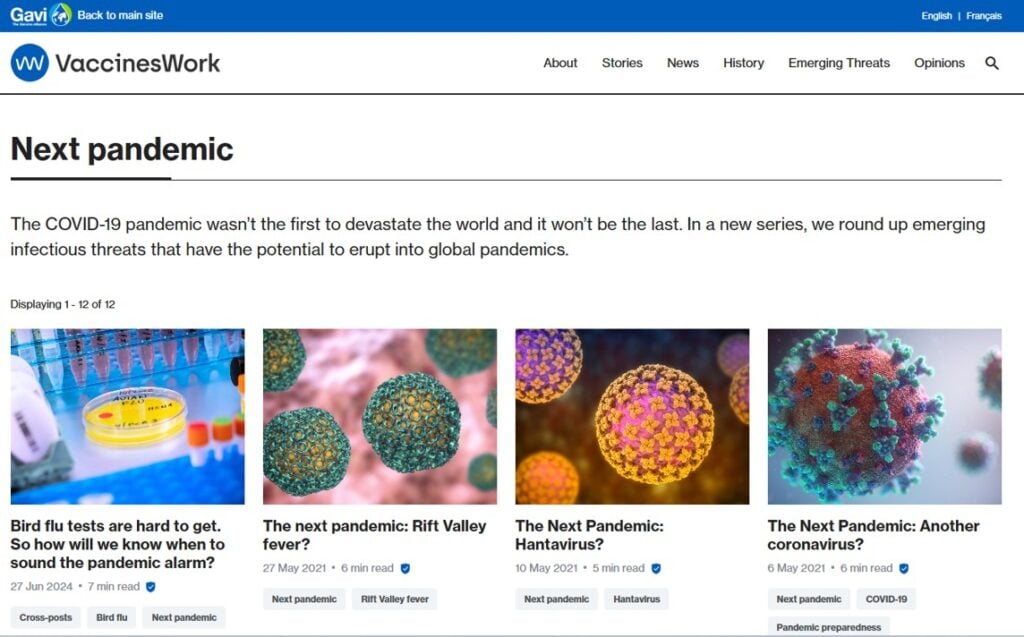
The Gates funded GAVI – The Vaccine Alliance has an entire page dedicated to The Next Pandemic. Hantavirus is in the running, along with other contenders we have written about such as Crimean Congo Haemorrhagic Fever, Marburg, and Bird Flu.
Ghebreyesus has also announced plans underway for increased research and development, including a need for further funding into “potential hantavirus therapeutics and vaccines“. Thirteen hantavirus vaccines are in the development pipeline already, including Moderna who had never successfully marketed a product until their covid vaccine; and the United States Army Medical Research Institute of Infectious Diseases (AMRIID).
Former Blackrock portfolio manager Edward Dowd has stated that “No one works on a virus with such low case count unless you think the market is going to grow.” For a review of the predictive programming being used across legacy media to prepare us to accept this market growth, see Pandemics, Pop Culture and Power.
Conclusion
It is undeniable at this time, that pandemic preparedness is a guise for a criminally sponsored financial architecture being built around us. For a virus with extremely low case count, but which infects many thousands of people every year, it is clear that the MV Hondius situation is being exploited by those with nefarious intent.
Whilst diseases of public health significance such as tuberculosis (which kills 4,000 people per day) and malaria (2,000 deaths per day, largely very young children) lose their priority in this new structure, vaccines are the excuse for public funds to be laundered into corporate coffers. In his recent article Why is the WHO Driving a Hantavirus Panic?, physician and infectious disease epidemiologist Dr David Bell explores the motives for the destruction of public health.
Gain of function, a euphemism for bioweapons research, is a pivotal feature of this business model. Across the globe scientists are funded to bioengineer pathogens, making them more transmissible and/or more dangerous, in order to justify new vaccines. The harms are doggedly ignored, as pseudoscience takes an ever-firmer hold in our health systems.
Stay alert. Question everything. Do not allow fear to cloud your decision making.












Can you please check the ‘rate this’ option above as I tried to rate it as 5 and it showed up as 2. Excellent article!
Ditto the comment below.
This is the second time I’ve wanted to rate your articles 5 STAR and it just rates one when I hit the first left hand star and try to “swipe” across.
Perhaps check it’s functionality
Write an instruction on how it’s meant to work.
Include an “Undo” function as seen on sone ratings mechanisms.
Maybe I’m doing it wrong but it’s clear now I’m not the only one.
Excellent article.