
Open Letter to PM Challenges Royal Commission Phase Two Findings as Unlawful Under Bill of Rights

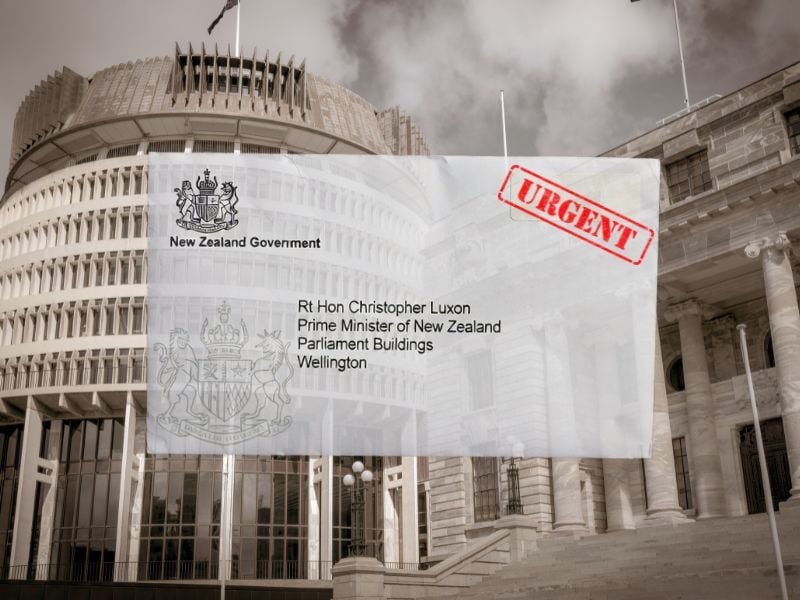
Justice Watch New Zealand has issued an open letter to Prime Minister Luxon challenging the Royal Commission’s Phase Two findings as unlawful under the New Zealand Bill of Rights Act.
Justice Watch NZ is a public advocacy and legal accountability group. In its third consecutive open letter to the Prime Minister and Government Ministers critiquing the Phase 2 report of the Covid Royal Commission, it argues NZ was rendered unfree and undemocratic such that the legal justification for the suspension of key elements of the Bill of Rights Act (BORA) claimed all along by the government and endorsed by the Commissioners, was rendered moot.
PUBLIC OPEN LETTER
Justice Watch New Zealand Inc.
Public Interest Correspondence
Email: [email protected]
Date: 17 March 2026
Subject: RCI into COVID-19: Lessons Learned Phase 2 — Legal Failure to Apply the Justified Limitations Framework of the New Zealand Bill of Rights Act 1990
Rt Hon Christopher Luxon
Prime Minister of New Zealand
And to:
All Honourable Ministers of the Crown
Dear Prime Minister and Honourable Ministers,
Purpose of this Letter
We write to explain why the Royal Commission’s Phase Two Report: Lessons Learned from Aotearoa New Zealand’s Response to COVID-19 appears to have failed to identify the misuse of the “justified limitations” provisions of the New Zealand Bill of Rights Act 1990. In our view, this arises from a misunderstanding of key aspects of the COVID-19 circumstances and their proper application within the legal framework established by the Act.
The Required Legal Approach
The proper legal approach is to measure the circumstances that occurred during the pandemic against the statutory framework that existed at the time. The law cannot be adjusted retrospectively to accommodate the circumstances that arose. Rather, the circumstances must be examined against the requirements of the law as enacted by Parliament.
The law is prescriptive in this regard. Section 10 of the Legislation Act 2019 provides that “the meaning of legislation must be ascertained from its text and in the light of its purpose and context.” Any analysis of the justified limitations provisions of the New Zealand Bill of Rights Act must therefore begin with a careful examination of the text of the Act and the purpose and context in which those provisions were enacted.
Constitutional Role of the New Zealand Bill of Rights Act
The New Zealand Bill of Rights Act also occupies a particular constitutional role within New Zealand law. It is one of the few statutes enacted primarily to restrain the exercise of public power rather than to regulate the conduct of the public. In that sense, it is legislation enacted for the protection of the people against the misuse of governmental authority. For that reason, the rights affirmed by the Act must be interpreted liberally and applied for the benefit of the people whose freedoms the Act was designed to protect.
The Statutory Test Under Section 5
Section 5 of the New Zealand Bill of Rights Act 1990 is explicit that any limitation on the rights and freedoms affirmed by the Act is permissible only where it can be demonstrably justified in a free and democratic society.
The statutory language is clear that the concept of justification operates within the context of a society that is itself free. Yet during the pandemic New Zealand society was placed under lockdown conditions removing the element of freedom that is required for further justified limitations. In those circumstances the question necessarily arises whether additional limitations imposed while that condition existed could properly be said to meet the statutory requirement of justification under section 5.
Sequence of Rights Limitations
In those circumstances it is necessary to identify the sequence of rights limitations that occurred.
This sequence also raises a further issue of legal reasoning. Where successive limitations on rights derive their force from conditions created by earlier restrictions, the justification analysis risks becoming circular, because the State is effectively relying upon circumstances produced by its own limitations in order to justify additional ones.
The first limitation was the removal of ordinary freedom of movement and association through lockdown orders imposed across New Zealand.
Once those conditions were established, the restoration of ordinary freedoms was then made conditional upon vaccination uptake targets. In practical terms, the return of ordinary civil liberties was tied to vaccination compliance.
The effect of this sequence was that the restoration of ordinary freedoms was made conditional upon vaccination uptake. In substance this created a coercive environment in which individuals were pressured to accept a medical intervention, and it is now evident that some New Zealanders who complied with those conditions were subsequently injured.
Schematic Representation of the Issue
The issue can be illustrated schematically as follows:
Statutory Requirement
New Zealand Bill of Rights Act 1990 — Section 5
Limitations permitted only where demonstrably justified
IN A FREE AND DEMOCRATIC SOCIETY

Circumstance That Occurred
Nationwide lockdown orders imposed across New Zealand
The practical effect of those orders was the removal or severe restriction of the ordinary civil freedoms that define a free society, including:
- Freedom of movement — people were required to remain at home and were prohibited from travelling except for limited purposes.
- Freedom of association — people were prohibited from meeting with others outside their household.
- Freedom of peaceful assembly — public gatherings were prohibited.
- Freedom to carry on ordinary work and livelihood — many people were prohibited from attending workplaces or conducting normal economic activity.
In those conditions New Zealand society was operating under lockdown restrictions in which the ordinary freedoms presupposed by section 5 of the New Zealand Bill of Rights Act were substantially removed.

Further Limitation
Restoration of ordinary freedoms made conditional upon vaccination uptake targets.
Practical Effect
Individuals pressured to accept a medical intervention in order to regain ordinary civil liberties.
Observed Outcome
Some individuals who complied with those conditions were subsequently injured.
Issue Identified
The Royal Commission does not appear to analyse this sequence of limitations within the statutory requirement that justification occur in a free and democratic society.
Conclusion
The Phase Two report appears to reach conclusions about justified limitations without properly examining the statutory condition required by section 5 of the New Zealand Bill of Rights Act 1990 — namely, that any limitation must be demonstrably justified in a free and democratic society.
In our submission, any limitations imposed on the population at a time when New Zealand society was not operating as a free and democratic society — or where individuals were subject to conditions of coercion — were incapable of meeting the statutory threshold for justification under section 5. It follows that such limitations must properly be regarded as unlawful, as they fall outside the limits permitted by law. In that context, the conclusions reached by the Commissioners in the Phase Two report are in error.
Where such unlawful limitations have contributed to outcomes involving serious harm, including injury or death, the question of legal responsibility necessarily arises and cannot properly be set aside.
Yours faithfully,

Andrew Major
Chairman & Lead Investigator
Justice Watch New Zealand Inc.
(Incorporated Society)
Email: [email protected]
Website: www.justicewatchnz.net
Distribution:
Prime Minister and all Ministers of the Crown

Download the Justice Watch NZ Letter (PDF): Challenging Royal Commission Phase Two Legal Failure on Bill of Rights
Read the other Justice Watch NZ Letters:
- Letter One: Open Letter to Prime Minister Christopher Luxon Challenges Evidence Behind Pfizer Vaccine Safety in New Zealand
- Letter Two: Open Letter to PM Challenges Royal Commission Phase Two Silence on Non-Derogable Rights and Myocarditis Fatalities







Fantastic that you people from Justice watch have devoted you time, energy and legal knowledge to expose in a well reasoned manner shortcomings of the Royal Commission. Many New Zealanders felt from the outset that gross bias existed in that commission. This became already evident with the choice of considered evidence. Also in the reporting of findings. Your letter places that feeling in a legal framework. This must lead to prosecution of those responsible for the violations of the Bill of Rights Act. The victimes of the Covid vaccination policies, amongst which was the unjustified cutting of freedom rights, deserve at least a sincere apology. Also that those who were accountable will be called to account.
Thanks Peter,
You are quite right—accountability is required.
The circumstances are plain and clear. There are demonstrable and apparent violations of the law resulting in harm being inflicted. There appears to be no lawful justification or excuse. In those circumstances, accountability is not optional—it is required.
On the present understanding, the situation appears to be unlawful.
Our team at Justice Watch NZ http://www.justicewatchnz.net is actively investigating this matter within the criminal law context.