
Open Letter to PM Challenges Royal Commission Phase 2 Safety Conclusions and Representation of Harm

Justice Watch New Zealand has issued an open letter to Prime Minister Luxon challenging the Royal Commission’s Phase Two safety conclusions, raising concerns about evidential reliability and the underrepresentation of vaccine-related harm.
This final letter on vaccine safety to government from Justice Watch NZ covers some of the plain-sight methods the RCI Commissioners used to diminish covid injection safety concerns, including particularly the notion that if billions of doses were used the injections must somehow be safe. At the same time the Commission acknowledges some harms but still contends they were safe and effective – ignoring large amounts of evidence to the contrary – because government experts say they are. The Justice Watch team conclude in their summary that:
“this advances a position in which accepted harm is implicitly treated as justified without establishing a lawful basis for that conclusion. Where harm is accepted, and where continued use results in continued injury, the product cannot properly be characterised as safe in absolute terms. It must also be recognised as dangerous to those individuals who are harmed, and its use assessed accordingly within a framework that gives full effect to individual rights.”
The good ship New Zealand is dangerously adrift from its anchoring human rights legislation, and many of its passengers still have no idea, despite many “armchair admirals” clanging the warning bell. Justice Watch, NZDSOS and other concerned groups are not prepared to stand by and watch the government ignore important principles of law and science and implement the Commission’s recommendations.
PUBLIC OPEN LETTER
Justice Watch New Zealand Inc.
Public Interest Correspondence
Email: [email protected]
Date: 20 March 2026
Subject: Representation of Harm and Reliability of Safety Conclusions in the COVID-19: Lessons Learned Phase 2 report.
Rt Hon Christopher Luxon
And to:
All Honourable Ministers of the Crown
Dear Prime Minister and Honourable Ministers,
I write on behalf of Justice Watch New Zealand Inc. regarding the treatment of vaccine-related harm in the recent report addressing the use of Comirnaty during the COVID-19 response.
As previously raised in our correspondence of 11 March 2026, 12 March 2026, and 17 March 2026, concerns have been identified regarding the evidential foundation relied upon in assessing safety, and the legal framework applied to justify limitations on rights during the pandemic response.
The report places reliance on the fact that billions of doses have been administered, and on that basis asserts that no delayed-onset adverse events have been observed and that there is no strong or consistent evidence of broader harm.
This correspondence addresses a matter of legal and factual accuracy, namely whether those conclusions are demonstrably supported, and whether the acknowledged harm is properly represented.
This letter addresses the following matters:
- Reliance on Scale Does Not Establish Safety
- Unsubstantiated Symptom Classification
- Effect on Safety Conclusions
- Acknowledgement of Harm
- Ongoing and Inevitable Incidence of Injury
- Legal Characterisation of Safety
- Legal Rights
- Non-Derogable Rights and International Law
- Comparison with the Doctrine of Self-Defence
- Structural Impossibility of Lawful State Harm
- Arbitrary State Conduct and the Rule of Law
- Conclusion
Reliance on Scale Does Not Establish Safety
The reliance on the number of doses administered does not, of itself, establish safety.
It assumes that adverse outcomes are:
• correctly identified,
• accurately classified,
• and reliably attributed.
That assumption is not examined.
Where the underlying classification framework is imprecise or overly generalised, conclusions drawn from large-scale data may be systematically understated.
Unsubstantiated Symptom Classification
The report proceeds on the basis of broad symptom categories, without sufficiently examining whether those classifications accurately reflect the underlying medical condition.
In this context, the product was introduced with a fixed symptom classification framework determined at a point in time before broader clinical observation was possible. The use of the product expanded rapidly, while the ability to fully understand and interpret symptom presentation was necessarily limited by time.
In other words, there was insufficient time to determine the complete clinical meaning of many symptoms before they were classified, often as non-serious, and relied upon in the safety profile of the product.
For example, symptoms such as headache are commonly recorded as minor or non-serious adverse events.
However, a headache may equally be:
• a benign and transient symptom, or
• an early manifestation of a serious neurological or vascular condition, including inflammatory or clotting-related pathology.
Without clinical investigation, differentiation between these possibilities is not possible.
In those circumstances, classification of such symptoms as “non-serious” is not a finding of fact, but an assumption.
A symptom is not a diagnosis. Where classification stops at symptoms, the underlying injury may remain unrecognised.
Effect on Safety Conclusions
Where symptom classification operates at this level of generality, the resulting data cannot reliably support conclusions that:
• serious harm is rare, or
• delayed or complex injury does not occur.
If serious conditions are recorded at the level of general symptoms, the true nature and extent of harm may not be captured.
In that context, reliance on aggregate dose numbers, combined with broad symptom categorisation, risks producing conclusions that are not demonstrably supported by the underlying evidence.
Acknowledgement of Harm
The report acknowledges that Comirnaty does cause harm. It accepts that the vaccine causes myocarditis in some recipients and that, in a number of cases, this has resulted in serious injury and death.
This is a critical point. It establishes that harm is not theoretical — it occurs in fact.
Where causation is accepted, these outcomes must properly be characterised as injuries caused by the product.
The report accepts that Comirnaty causes harm, including serious injury and death, while maintaining its overall safety profile and supporting its continued use. The effect of that position is to treat such harm as a justified consequence of the product’s deployment.
However, where that harm engages fundamental rights protected under Article 6 of the ICCPR and sections 8 and 10 of the New Zealand Bill of Rights Act 1990, the legal threshold for justification is necessarily exacting. The report does not demonstrate that this threshold has been met, nor does it establish that it could properly be met in the circumstances described.
In that sense, the report advances a position in which the occurrence of harm is both accepted in fact and treated as justified in law. That position cannot be reconciled with a legal framework that prohibits the arbitrary deprivation of life and the infringement of non-derogable rights.
Ongoing and Inevitable Incidence of Inquiry
Once it is accepted that the product does cause injury, it follows that, in the absence of any change to the underlying cause, its continued use will result in further injury.
This is the direct and foreseeable consequence of administering a product known to cause harm in a proportion of recipients.
Accordingly, whenever the product is used, some individuals will be injured to the extent that the risk manifests.
Legal Characterisation of Safety
In that context, the characterisation of the product as “safe” cannot be sustained in any absolute sense.
A product that is:
• safe for some, and
• injurious to others
cannot properly be described as safe. It is, by its nature, selectively harmful.
Where use involves human beings—each of whom holds an individual and non-derogable right to life and bodily integrity—the existence of a known risk of serious injury or death is legally significant.
Rights are held individually, not collectively.
A product which, when administered, will injure some individuals must therefore also be recognised as dangerous to those affected, even if not to all.
Legal Rights
The relevant issue is not the scale of use, nor the reputation of the product.
The issue is:
• the legal rights of those who are harmed, and
• the lawful authority of the Government and its representatives to expose individuals to a course of action that results in such harm.
Where the State adopts, promotes, or sustains the use of a product that is acknowledged to cause injury, the question arises whether:
• such harm was lawfully imposed,
• lawfully risked, or
• imposed without sufficient legal foundation.
This requires explicit examination.
Non-Derogable Rights and International Law
Under Article 4 of the International Covenant on Civil and Political Rights, States may take measures derogating from certain obligations only “in time of public emergency which threatens the life of the nation.”
However, the same provision expressly provides that no derogation may be made from certain rights, including the right to life under Article 6.
The Siracusa Principles further provide that:
“No limitation on or derogation from any of the non-derogable rights recognised in the Covenant is permitted.”
They also require that any limitation must be:
“strictly necessary in a democratic society,”
“proportionate to the objective,”
“not arbitrary.”
These provisions establish that even in circumstances where the State itself may be under existential strain, there remains an absolute legal boundary. The State may act to preserve public order, but it may not do so in a manner that results in the arbitrary deprivation of life or the infringement of inalienable rights.
This reflects a fundamental constitutional principle: individuals cannot be sacrificed by the State, even in pursuit of a perceived collective benefit.
Comparison with the Doctrine of Self-Defence
The limits on State action are further clarified when compared with the legal doctrine of self-defence.
Self-defence permits the use of force only where strict conditions are met:
• the force must be necessary to prevent death or serious harm,
• it must be proportionate,
• there must be no reasonable alternative,
• the parties must be present to the immediate threat.
Even under these strict conditions, harm is tightly confined.
When these principles are considered alongside the ICCPR, the Siracusa Principles, and the New Zealand Bill of Rights Act 1990, it becomes clear that the State is subject to even greater constraint.
Structural Impossibility of Lawful State Harm
The lawful exercise of self-defence depends upon immediate and individualised assessment.
The person acting must be present to the threat and able to assess necessity and proportionality in real time.
The State cannot do this.
It cannot be present in each individual circumstance. It cannot assess the specific position of each person. It cannot determine, on an individual basis, whether harm is necessary, proportionate, or avoidable.
This is not a practical limitation. It is a structural impossibility.
Because the State cannot meet the conditions required for lawful defensive harm in relation to each individual, it cannot rely on those principles to justify the imposition of harm across a population.
Accordingly, any such harm cannot be characterised as defensive. It assumes an arbitrary character, and arbitrary State conduct is repugnant to governance under the Rule of Law, under which public power is exercised for the people and constrained by law.
Arbitrary State Conduct and the Rule of Law
Given the causative and arbitrary nature of the resulting injury, this outcome is fundamentally inconsistent with the constitutional protections afforded to those individuals.
Arbitrary State conduct is antithetical to democratic governance. It represents a departure from the Rule of Law and aligns instead with an approach in which power is exercised without sufficient legal constraint.
The Rule of Law requires that all exercises of public power be lawful, rational, and consistent with protected rights. Where harm is imposed in circumstances that do not meet those requirements, the action falls outside that framework.
Conclusion
In our submission:
• the report relies on scale without establishing the reliability of its underlying classifications,
• it acknowledges that the product does cause harm, but
• does not adequately represent the magnitude, nature, and ongoing incidence of that harm,
• and advances a position in which accepted harm is implicitly treated as justified without establishing a lawful basis for that conclusion.
Where harm is accepted, and where continued use results in continued injury, the product cannot properly be characterised as safe in absolute terms.
It must also be recognised as dangerous to those individuals who are harmed, and its use assessed accordingly within a framework that gives full effect to individual rights.
Closing
We respectfully raise this matter for your consideration, given its importance to public understanding, the protection of individual rights, and the proper application of the Rule of Law in New Zealand.

Andrew Major
Chairman & Lead Investigator
Justice Watch New Zealand Inc.
(Incorporated Society)
Email: [email protected]
Website: www.justicewatchnz.net
Distribution:
Prime Minister and all Ministers of the Crown
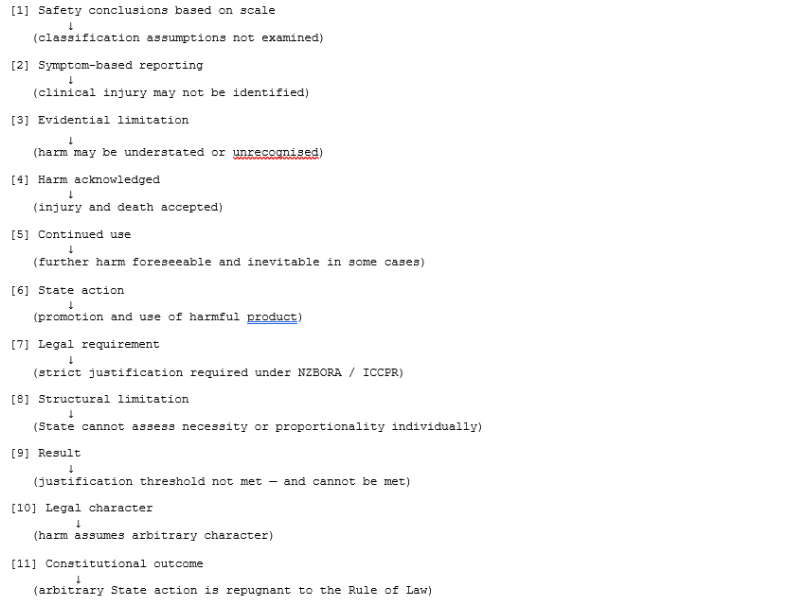
Attachment: Logical Structure of Legal Analysis
Summary Flow from Evidence to Legal Conclusion

Download the Justice Watch NZ Letter (PDF): Royal Commission Phase Two Safety Conclusions and Representation of Harm
Read the other Justice Watch NZ Letters:
- Letter One: Open Letter to Prime Minister Christopher Luxon Challenges Evidence Behind Pfizer Vaccine Safety in New Zealand
- Letter Two: Open Letter to PM Challenges Royal Commission Phase Two Silence on Non-Derogable Rights and Myocarditis Fatalities
- Letter Three: Open Letter to PM Challenges Royal Commission Phase Two Findings as Unlawful Under Bill of Rights







And who thought this commission would come up with real answers ??
NOT me.
This lot could well be bought by :: yeah, right
What a waste of money and time.
This clot shot should have been pulled after 5 or 6 deaths like the Swine flu jab.