World Health Organization Collaborating Centres Ensuring Local Implementation of Global Agenda

Lucinda van Buuren is a qualified registered nurse in Australia who lost her job due to the vaccine mandates in 2021. She voluntarily surrendered her registration with the Australian Health Practitioner Regulation Agency (AHPRA) in April of 2026 on ethical grounds. A member of the World Council for Health Australia, for two years Lucinda has been voluntarily investigating a little-known but long-established and globally disseminated mechanism known as World Health Organization Collaborating Centres (WHO CCs).
Most of the information in this article was obtained via interviews with and presentations by Lucinda. The information reinforces further, concerns we have already shared about the WHO, for example a call for NZ to Exit the WHO, international collaborations involving the Medical Council of New Zealand and not least of all, evidence of plans for world governance.
The World Health Organization (WHO) defines a WHO Collaborating Centre as “an institution designated by the Director-General of WHO to form part of an international collaborative network set up by WHO in support of its programme at the country, intercountry, regional, interregional and global levels.” WHO CCs are divisions, departments, units or other parts of universities, research institutes, hospitals, academies or governments, which have successfully collaborated with WHO on jointly planned activities for at least two years prior to designation.
The WHO CC mechanism was created in 1949 at the second World Health Assembly and in 1955 the Venezuelan Centre for Classification of Diseases became the first designated WHO CC. The first network of WHO CCs was developed in 1992. A March 2026 media release states “Over time, the WHO Collaborating Centres network has evolved into a global community of academic, technical and public health institutions contributing expertise, research, training, laboratory services and technical advice to advance WHO’s programmes.“
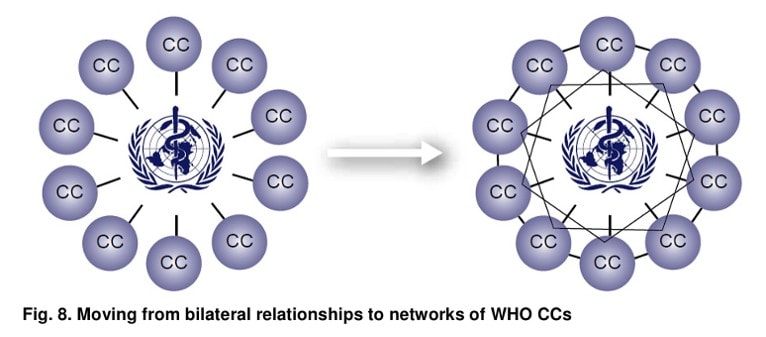
Lucinda describes the mechanism and networks as complicated by design, making meaningful scrutiny difficult. This illustration is from Page 30 of the Guide for WHO Collaborating Centres (“The Guide”).
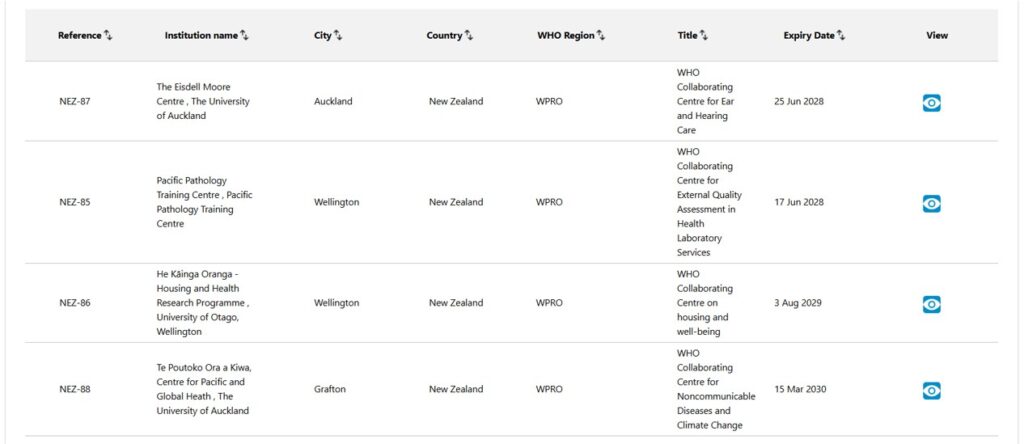
As at April 2026 there are over 800 WHO CCs in over 80 countries. According to the WHO CC database, New Zealand has four active WHO CCs, preceded by 84 prior WHO CCs according to the numbering system. Two of the currently active WHO CCs in New Zealand are at the University of Auckland, one at the University of Otago in Wellington and one at Pacific Pathology Training Centre in Wellington.
As stated in The Guide, described by Lucinda as the “document to read” if you want to understand WHO CCs, eligible institutions cannot apply or self-nominate. Collaborating Centre status can only be formalised by Director-General designation following proposal from within the World Health Organization after a minimum two year collaboration. The designation “provides a formal framework for future joint activities.”
The collaboration brings benefits to both parties. WHO gains access to top institutions worldwide and the institutional capacity to support its work. Similarly, institutions designated as WHO CC gain increased visibility and recognition by national authorities, and greater attention from the public for the health issues on which they work. The centres also gain opportunities to work together (e.g. sharing objectives, exchanging information, pooling resources and developing technical cooperation), particularly at the international level; and opportunities to mobilize additional and sometimes important resources from funding partners.
Once designated, WHO CCs are required to implement a list of detailed activities from a workplan, with each activity contributing to the achievement of a WHO task. Specific funding sources must be named in the workplan, and the Guide uses a description example on page 22 which infers prevalent financial procurement : “This activity will be funded by the B&M Gates Foundation or from the regular budget of the institution.” Clearly, there are economic rewards to any institution designated as a WHO CC.
In her May 2026 interview with Maria Zeee, Lucinda exposes the fact that WHO CC USA-289 is the Center for Biologics Evaluation and Research (CBER) at the Food and Drug Administration (FDA), who were responsible for approving the covid-19 injections. This raises serious questions in regards to likely conflicts of interest at CBER, which may explain why Dr Peter Marks, CBER Director at the time, was so confident in his dismissal of vaccine injury survivors?
Dr Marks is now Senior Vice President of Molecule Discovery and Head of Infectious Disease at Eli Lilly, a multinational pharmaceutical company with offices in 18 countries (aka “Big Pharma”). This is a prime example of the revolving door between regulators and the corporations they allegedly regulate.
In her recent interview with Del Bigtree, Dr Tess Lawrie describes the network of WHO CCs as informing the World Health Organization on the biosecurity health agenda. A wide range of subjects are covered by WHO CCs, but “there is a preponderance on pandemics, vaccines, pathogens, health security policy, health care systems and regulatory strengthening“. This surely comes as no surprise to those of us who have become aware of the plans for a “next pandemic”, where haemorrhagic fevers feature heavily, such as but not limited to Hantavirus, Ebola, Marburg, and Crimean-Congo HF.
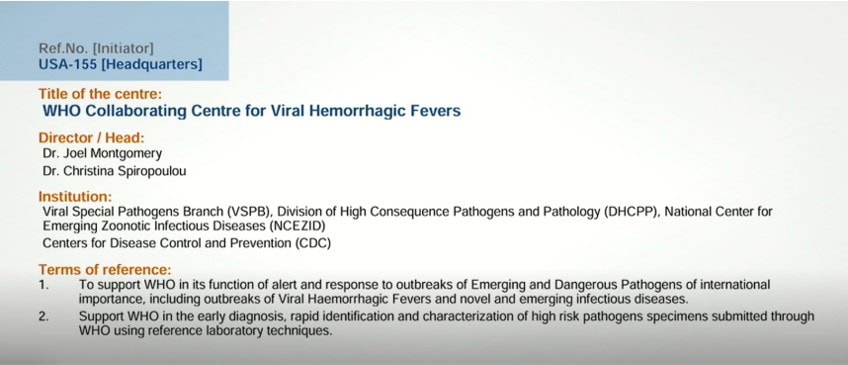
Whilst the USA claims to have exited the WHO, there are 70 active WHO CCs in the USA, 330 discontinued USA WHO CCs and 97 USA WHO CC numbers which cannot be accounted for. Directors Montgomery and Spiropoulou at USA-155, the WHO Collaborating Centre for Viral Hemorrhagic Fevers, are exposed by Dr Lawrie as heavily involved in gain of function research on viruses associated with haemorrhagic fever disease. A quick AI search confirms this claim, linking Dr Spiropoulou to a number of associated patents.
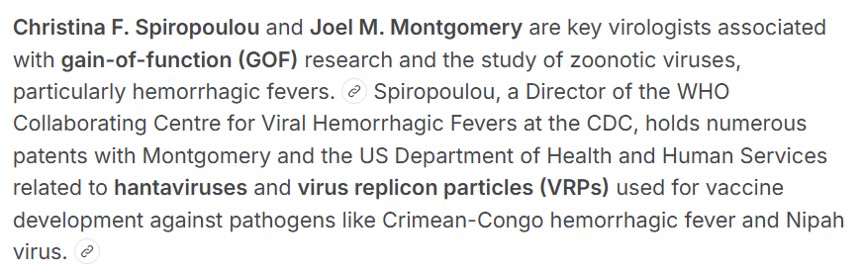
Prior database website access allowed for detailed search results on each WHO CC, and for reports to be generated providing useful information. Dr Lawrie explains that after she presented evidence taken from the database in an October 2025 meeting, these features were removed from the database search function. This infers that the World Health Organization are aware their activities can only succeed if there is no transparency or public scrutiny.
Freedom of Information requests from the World Council for Health to WHO CCs have also been generally ignored, suggesting that they are acting outside and above the law. Corporate funding of WHO CCs is apparent but the channels have been obscured by complex pathways.
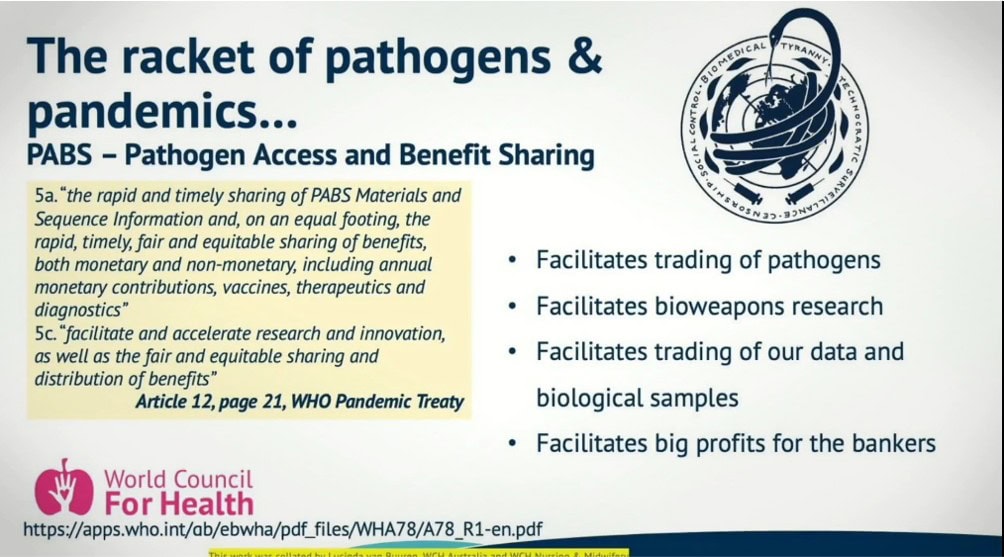
Dr Lawrie talks about the WHO Pandemic Treaty which is almost in place, pending the agreement of the Pathogens Access Benefits Sharing System (PABS System), summarised in the below slide. For more detail on the PABS System see this article. Gain of function (biowarfare) research, in which WHO CCs appear to be playing a pivotal role, is central to the business model.
The information exposed so far about WHO CCs by Lucinda and the World Council for Health suggests that government departments and publicly funded institutions such as universities and hospitals, can bypass their public interest obligations in favour of showing allegiance to the World Health Organization and their financial sponsors. This system meets the definition of fascism: a merger of state and corporate power in which citizens are required to conform to communal and commercial interests, ensuring increased profit and power to those in authoritative positions.
The New Zealand Connection
The global governance agenda is a collossal and complex web which will only succeed if local implementations can be established. WHO Collaborating Centres including Eisdell Moore Centre and Te Poutoko Ora a Kiwa at Auckland University; He Kāinga Oranga – Housing and Health Research Programme at University of Otago Wellington; and Pacific Pathology Training Centre at Wellington Hospital are actively assisting this global agenda. New Zealanders are largely unaware of the fact, and of the potentially dire consequences.
Investigations are needed into what activities are being undertaken at these institutions on behalf of the World Health Organization, and what the funding pathways and potential conflicts of interest are. Whilst each current New Zealand WHO CC has a statement on their website about their designation, what efforts are being made to inform the New Zealand populace about the implications of these designations? What are the 84 other institutions who have held WHO CC status and what activities did they undertake on behalf of the World Health Organization in New Zealand? If any of our readers have the capacity to assist with these investigations or disclosures, we would appreciate hearing from you.