The PVSC Tale Continues: Is Selective Reporting Clouding the Truth?

The Post Vaccine Symptom Check (PVSC) Tale Continues
Introduction
Some readers may recall the lengthy saga to try to get access to data from New Zealand’s active monitoring of vaccine safety – the Post Vaccine Symptom Check (PVSC). This was the data collected when random people were sent a text after their vaccination to ask about their health.
Despite OIA requests and a complaint to the Ombudsman, the data in the open text boxes was not made available.
The publicly released PVSC reports suggested all was well. People experienced mild and short-lived symptoms as expected – a bit of a sore arm, a headache, some flu-like symptoms…
However, a more recent attempt to get answers has resulted in some new information coming to light.
Rare Diagnoses
This sentence was noted on the Health NZ webpage regarding PVSC in late 2024:
“Other survey questions may ask about rare diagnoses that may have occurred in the weeks after their vaccination.”
[Intriguingly this sentence has been removed from the latest version of the webpage!]
Curiosity was piqued so the question was asked: ‘What were these ‘rare diagnoses’?’
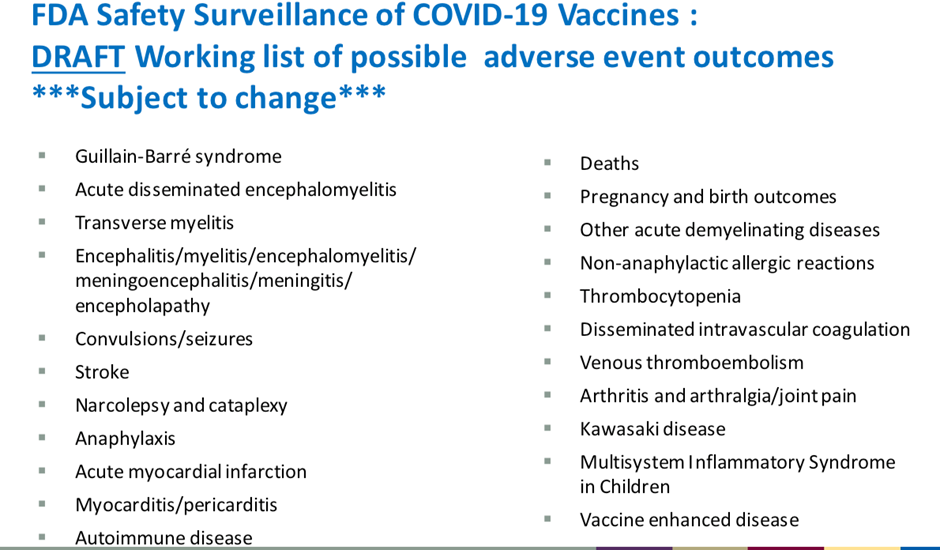
The initial response said this question was no longer asked and didn’t provide any information, so a repeat OIA request asked for the previous list. The following are the conditions New Zealand authorities were curious about following covid vaccination. Interestingly, although not an exact replica, this list aligns with what was anticipated during vaccine development as per the slide below from October 2020.
“Since the day 7 survey, have you been diagnosed by a medical professional with any of the following rare conditions after your vaccination? Please select all that apply.”
- Guillain Barre syndrome
- Bell’s palsy
- Inflamed nerves or nerve degradation (Neuritis or neuropathy)
- Any other neurological condition
- Seizures
- Febrile seizures
- Myocarditis
- Pericarditis
- Blood vessel issues
- Blood and lymphatic system disorders
- Immune system disorders
- Anaphylaxis
- Cellulitis
- Diagnosis of any other new conditions
There is nothing in the sanitised reports advising how many people selected which various conditions.
Medical Conditions Experienced Following Bivalent Vaccine
The bivalent survey in 2023 sent texts on day 7 and day 42 and as the above list of rare diagnoses was no longer included, it had a question that could be answered by free text.
“Since the day 3 survey have you been diagnosed with any medical conditions that a medical professional has attributed to your vaccination?”
The OIA request asked for the full list of things that people wrote down: ‘In addition to ‘viral infection’ and ‘asthma’ can you provide a full list of the conditions people mentioned in response to question 2 of the day 42 survey please.’
The answer was as follows below. We would like to reiterate the point that these conditions people reported, are not necessarily side effects and are not necessarily caused by vaccination. They are things people reported experiencing between day 3 and day 42 following their bivalent vaccine. In order to determine whether they are related to the recently received vaccination, a causality assessment would need to be done by medical staff at CARM trained in pharmacovigilance. From our discussions with injured people, we do not have confidence that thorough causality assessments are being done so it may not be possible to know whether they were causally related or not.
Despite the disclaimer, this list contains serious and potentially life-threatening medical conditions. It is hard to believe they would all be ‘coincidences’. Once again, the PVSC reports make no mention of these conditions or how frequently people reported them.
“Please note that the list below contains responses recorded by participants. As can be seen from some responses included this list, the source question may have been misinterpreted by some respondents, This is not a list of vaccine side effects and should not be interpreted as such.”
| Allergic Reaction | Amnesia | Arthritis | Asthma |
| Autoimmune hepatitis | Autonomic dysregulation | Bacterial infection | Bechet syndrome |
| Bell’s palsy | Breast cancer | Bronchitis | Cancer |
| Cardiac ectopic | Category | Cephalalgia (sic) | Cerebral palsy |
| Chest infection | Chest pains | Chest tightness | Chronic fatigue |
| Cold | Continual runny nose | COPD | Cough |
| Nasal congestion | Covid-19 | Depression | Diabetes |
| Diagnosed | Diarrhoea | Don’t know | Epilepsy |
| Erythema multiforme | Fainting | Low oxygen | Fatigue |
| Flu like symptoms | Gallstones | GERD | GIST |
| Guillain Barré syndrome | Headache | Heart failure | Heart issues |
| Heart palpitations | High blood pressure | High cholesterol | Hives |
| Hypertension | Inattention | Inflammation | Influenza |
| Influenza A | Lichen planus | Tiredness | Long covid |
| Loss of strength | Lung congestion | Lymphaden- opathy | Multiple sclerosis |
| Myalgia | Myocarditis | Myositis | Nerve damage |
| Neurological dysfunction | None | Osteoarthritis | Palpitations |
| Pericarditis | Phenomenon | Pneumonia | Polymyalgia rheumatica |
| Pregnant | Pyrexia | Racing heart | Rash |
| Respiratory ailment | RSV | Schizophrenia | Shingles |
| Shortness of breath | Shoulder bursitis | Sinus infection | Sinusitis |
| SIRVA | Skin rash | Soreness | Stroke |
| Sugar | Swelling | Tendonitis | Thyroid |
| Tiredness | Vaccination | Vaginal bleeding | Vertigo |
| Viral conjunctivitis | Viral infection |
12-18 year olds
The new information confirmed that none of the surveys included 12-18 yr olds. This group was at significant risk of adverse heart effects such as myocarditis and was at minimal risk from covid infection. In 2021 there had been discussion behind the scenes as to how many vaccines should be recommended for this group, and at one point it was suggested that a single dose should be sufficient for a young person to be considered ‘vaccinated’ in order to work. It would have been useful and interesting to know what sort of adverse events were experienced by this group.
CARM/ACC
Other questions in the bivalent survey included:
“Have you had a Centre for Adverse Reactions Monitoring (CARM) report submitted for your diagnosis?”
“Has an ACC claim been made for your diagnosis?”
The responses to these questions were not noted in the PVSC reports and we await a further OIA response to learn more.
Conclusion
As can be seen there has been obfuscation and selective reporting with regards to the active monitoring of c-19 vaccine safety in New Zealand.
We hope that the Covid Inquiry will look into pharmacovigilance in great detail – both the passive CARM system and this active post vaccine symptom check.