Broadcasting Authority Targets Health Advocates in Speech Control Test Run
NZDSOS was curiously listed as a “broadcaster” on the BSA complaints form – suggesting a coordinated effort to control online health discussions – before the listing was hastily removed after public outcry.
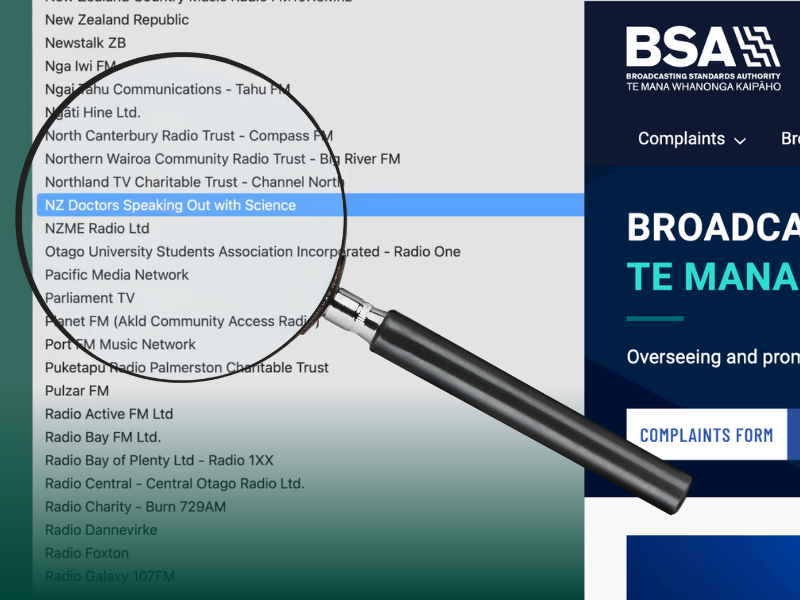
The Broadcasting Standards Authority (BSA) had NZDSOS listed as a “broadcaster” on its official complaints form – a designation that would give the government agency quasi-judicial power to order doctors off the internet for discussing medicine and health policy. The listing was hastily removed after public backlash this month, but the damage was done: the plan was revealed.
Dr Alison Goodwin was alerted to the listing by a supporter who was following the BSA’s controversial claim of jurisdiction over The Platform. “I was very surprised to see us there when I couldn’t see the likes of The Platform or Voices for Freedom or RCR on there,” she told broadcaster Sean Plunket. When asked by Sean Plunket later about why NZDSOS might be on such a list, Dr Goodwin said presumably someone thought NZDSOS were ‘spreading misinformation’. However, she also noted “Nobody will come and have a conversation with us… they won’t engage, and they won’t actually listen to what we have to say and come back with counterarguments. So I think they don’t like what we’re saying.”
Video: NZDSOS Listed as Broadcaster on BSA Complaints Form – Dr Alison Goodwin Interviewed by Sean Plunket
This isn’t a rogue regulator acting alone. According to patent attorney Claire Deeks’ analysis at RCR Media, the BSA was “testing public tolerance for speech controls ahead of the next government push.” When Minister Paul Goldsmith was asked about the controversy, he confirmed the BSA’s action sat “within the media reform package that went out for consultation” and said he was “happy to let any court action “flow through the system.”
The BSA isn’t independent – it’s a Crown entity accountable to the Minister for Media and Communications, with board appointments made on ministerial advice. This wasn’t rebellion. It was reconnaissance.
The Pattern Behind the Power Grab
The BSA episode fits a clear trajectory:
- The abandoned Safer Online Services review (defeated by 18,000+ submissions in 2024) proposed fines for content deemed “harmful” to emotional or mental wellbeing
- The 2025 Media Reform consultation reintroduced the same concepts under different branding
- The BSA’s jurisdiction grab aligned perfectly with these government plans
Former Judge David Harvey called it “a power grab by the BSA to get jurisdiction over pretty much any [online] platform.” Political commentator David Farrar warned: “Once you go past the normal definition of broadcaster, it’s very hard to say where the slippery slope stops.”
Why Health Advocates Should Care
For organisations like NZDSOS, the implications are stark:
- Smaller groups lack the compliance resources that state-funded media possess
- “The process is the punishment” – bureaucratic entanglement becomes censorship by exhaustion
- Standards around “harm” and “safety” can capture legitimate health discussions that challenge official narratives
The timing is telling. The BSA controversy coincided with ramped-up public health messaging around measles, including 1News reporting that “experts” stress measles is “far more deadly than covid-19” – a comparison used to justify stay-home orders for hundreds over two cases at Wellington colleges.
When mainstream media amplifies fear-based narratives without critical analysis, who provides balance? And what happens when regulators gain power to silence those alternative voices?
The Global Context
New Zealand’s developments mirror international trends where “safety” rhetoric masks speech control:
- Australia’s eSafety Commissioner can order content removal within 24 hours
- UK police make over 30 daily arrests for social media posts deemed offensive
- Canada’s Online Harms Bill C-63 empowers investigations for “hateful statements”
Each system is sold as protection. Each narrows the boundaries of acceptable speech.
What Free Speech Means for Health Freedom
In a genuinely free society, governments have no mandate to regulate speech beyond existing laws covering incitement, defamation, and crime. Once governments define what’s “safe” to say, truth itself becomes a matter of permission.
For health advocacy, this is existential. Informed consent requires access to diverse information sources. Debate over treatment approaches, vaccine safety, and public health policy requires space for dissenting voices – even unpopular ones.
New Zealand already has laws covering discrimination, privacy, deception, and harassment. What exactly needs additional regulation? Hurt feelings? Unpopular medical opinions? Lawful dissent from official health guidance?
When authorities refuse to engage in debate but instead seek regulatory power to control the conversation, it reveals the weakness of their position.
It seems the government does not want you being able to hear a variety of opinions and make up your own mind. It wants to continue Jacinda’s legacy of being ‘the single source of truth’.
The Bottom Line
As Claire Deeks concludes: “The BSA knew what it was doing. It didn’t go rogue; it went first.”
The BSA’s clumsy overreach revealed the plan before it was ready – and public backlash forced a retreat. But as Judge Harvey observed: “Policy ideas rarely die; they hibernate.”
For health advocates, doctors, and citizens concerned about informed consent, vigilance isn’t paranoia when the pattern is this clear.
Read the full legal and political analysis: The BSA Didn’t Go Rogue – It Went First by Claire Deeks at RCR Media.